Rocket Arcade Games
On this page
Rocket games are about controlling power. Where a shooter hands you a gun and a dodger hands you a steering wheel, a rocket game hands you an engine and a fuel tank, then asks you to spend both wisely. This guide covers the two main kinds of rocket arcade game and how to get better at each.
Two kinds of rocket game: climbers and landers
Rocket arcade games tend to split into two families:
- Climbers send your rocket upward through a stream of hazards. Speed and pressure rise the higher you get, and the score measures how far you made it. Rocket Rush is our climber.
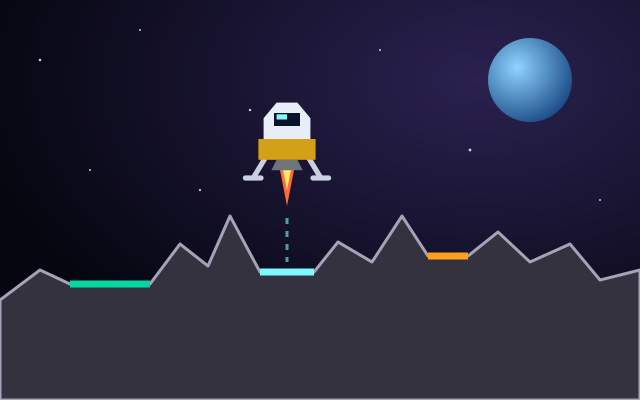
- Landers ask you to fight gravity with short bursts of thrust and touch down gently. Precision matters more than speed. Rocket Landing is our lander.
Two other games carry rocket elements too. Gravity Orbit is about launching a probe with the right power, and the Daily Space Challenge is a timed flight course. The table sums up how they differ:
| Game | Core challenge | Limited resource | Score |
|---|---|---|---|
| Rocket Rush | Climb through meteors, mines and barriers | Fuel (drains constantly) and 3 hull points | Altitude plus pickups |
| Rocket Landing | Touch down on a flat pad slowly and upright | Fuel (carries over) and 3 landers | Pad multiplier × (base + fuel bonus) |
| Gravity Orbit | Charge and release a launch to reach a wormhole | 3 attempts | Level bonus, stars, fewer-attempts bonus |
| Daily Space Challenge | Fly a 60-second course through gates | 3 hull points and the clock | Gates, stars, avoiding asteroids |
Rocket Rush: climbing on a fuel clock
In Rocket Rush, you steer with the arrow keys, WASD or the joystick while the world scrolls downward as your rocket climbs. Fuel drains constantly, so you must collect fuel canisters to keep going. Hazards come in three kinds: meteors, floating mines and debris barriers with a gap. Your hull has three points, speed increases with altitude, and the run ends when either fuel or hull reaches zero.
The game is a balance between two ways to lose. Playing too safely means missing canisters and running dry; chasing every canister means taking hits. Useful habits:
- Prioritize barriers. A debris barrier only has one gap, so line up with it early. Meteors and mines can be dodged at the last moment; a barrier cannot.
- Collect canisters that sit near your line. If reaching a canister means crossing the path of a mine, wait for the next one unless your fuel is low.
- Watch fuel and hull together. With full hull and low fuel, a hit to reach a canister can be worth it. With one hull point left, it never is.
- Expect speed. Since speed rises with altitude, shift your attention further up the screen as you climb.
Rocket Landing: the art of the gentle touchdown
Rocket Landing uses thrust and rotation. Up, W, Space or the THRUST button fires the main engine, and Left/Right rotate the lander. Gravity pulls you down constantly. To land, you need a flat pad, low vertical speed, low horizontal speed and a near-upright angle. The HUD shows your speeds and tells you OK or TOO FAST.
A step-by-step approach that works well:
- Pick your pad early. Smaller pads have higher multipliers (x2, x3, x5). Decide whether to go for a big multiplier before you start drifting toward it.
- Kill sideways speed high up. Tilt slightly, thrust briefly to move toward the pad, then tilt the other way to stop. Doing this near the ground is much harder.
- Return to upright. Once over the pad, rotate back to near vertical so your engine pushes straight up.
- Descend with short pulses. Tap thrust to keep the descent slow and watch the HUD. Aim to see OK well before touchdown, not at the last instant.
- Do not hover. Hovering burns fuel, and fuel carries over between landings.
That last point is what makes Rocket Landing a campaign rather than a series of separate puzzles. Each landing moves you to a new moon with different terrain and gravity, and the fuel you save on one landing is the fuel you have on the next. Your score also includes a fuel bonus, so efficient landings pay twice.
Launch-based rocket play
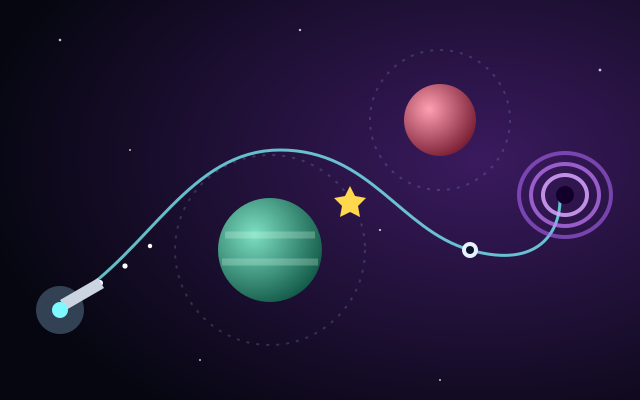
Gravity Orbit is a different kind of rocket game: you control everything before the launch and nothing after it. Aim, then hold Space or LAUNCH (or press and hold on the game) to charge power, and release. The short dotted preview shows your starting direction, but the planets' pull bends the path beyond it. The rocket-game skill here is consistency: charge to roughly the same power each time while adjusting aim, so you can tell what each change actually did.
A daily rocket course
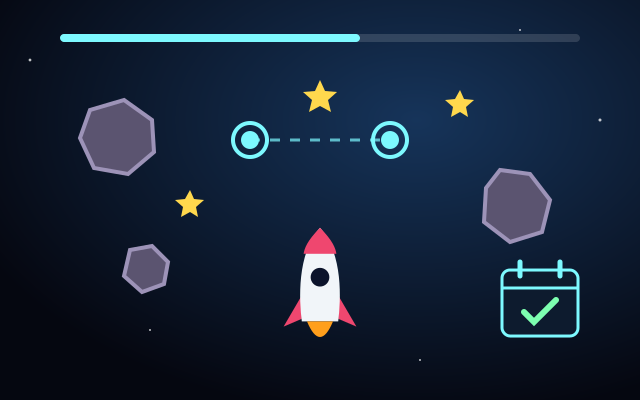
The Daily Space Challenge generates a 60-second flight course from the current date (UTC), so everyone gets the same layout on the same day. You fly through gates for a bonus, collect stars and avoid asteroids, each of which costs one of three hull points. Because the course repeats all day, it rewards the same planning habits as Rocket Landing: learn the layout, then refine your line. Your best score for the day is saved locally, and a Share button lets you share your result.
How real rockets differ from arcade rockets
As a real-world concept, a rocket moves by pushing exhaust out of its engine in one direction, which pushes the rocket the other way. In the vacuum of space there is no air to slow a spacecraft down, so it keeps its speed until another force, such as thrust or gravity, changes it. Landing on a body with no atmosphere means relying on engine thrust alone to slow down, with no help from air resistance or parachutes.
Our rocket games borrow the broad shape of those ideas, like limited fuel, gravity pulling you down and thrust to counter it, but every value is tuned for play. Nothing here reflects how real spacecraft are flown, and the games do not teach piloting. For a fuller comparison of arcade movement and real motion, read our space game physics explainer.
Key takeaways
- Climbers like Rocket Rush balance fuel against hull; landers like Rocket Landing reward precision.
- In Rocket Rush, line up with barrier gaps first and only chase canisters near your line.
- In Rocket Landing, cancel sideways speed high up, land upright with short pulses and save fuel for later moons.
- Real rocket physics is far more complex; these games simplify it for fun.
See all titles in the Rocket Games category.
Sources and further reading
- NASA Space Place (general-audience science)
- ESA: Science & Exploration