Space Flying Games Guide
On this page
In a flying game, the ship is the whole game. There is often nothing to shoot, so every point comes from where you fly and how cleanly you get there. The first thing to learn in any flying game is which movement style it uses, because each one rewards different habits.
Five movement styles
Our flying games use a handful of distinct movement styles. The table shows which game uses which, so you can match your habits to the game:
| Style | How it works | Our games |
|---|---|---|
| Lane movement | Left and right only, near the bottom of the screen | Asteroid Dodge |
| Free movement | Move in any direction with keys or a joystick | Rocket Rush, Alien Escape |
| Drag to steer | Free movement plus the option to drag with a mouse or finger | Star Collector, Daily Space Challenge |
| Thrust and rotate | Point the craft, then push with the engine against gravity | Rocket Landing |
| Launch and glide | Set direction and power, then let the path play out | Gravity Orbit |
Asteroid Dodge also supports dragging on the game, but its ship still only moves sideways. The exact keys and touch layouts are covered in our space game controls guide, and phone-specific advice is in our mobile controls guide.
Lane flying: fewer options, faster decisions
With only two directions, lane movement makes every decision binary: left or right, now or later. In Asteroid Dodge, rotating asteroids of different sizes fall while speed and density rise with distance, and a near-miss bonus rewards passing close. Lane-flying habits:
- Stay central when you can. From the middle you can go either way; from an edge you can only go one.
- Move early and small. A short tap in time beats a long slide at the last moment.
- Read two rows ahead. The gap you take now should lead to a gap you can take next.
Free flying: choosing a line
Free movement gives you more choices, which also means more ways to make a bad one. The key idea is the flight line: a smooth path you plan through the next few seconds of the screen, rather than a series of jerky reactions.
In Rocket Rush, the world scrolls down as you climb. Debris barriers have a single gap, meteors and floating mines come between them, and fuel canisters must be collected because fuel drains constantly. A good flight line starts at the next barrier's gap and works backward: where do you need to be when the barrier arrives, and which canisters and dodges fit along the way?
In Alien Escape, the line is shaped by patrol drones' detection cones and laser gates that switch on and off on a rhythm. Here, a good line includes pauses: flying is as much about when you move as where.
Drag flying and collection routes
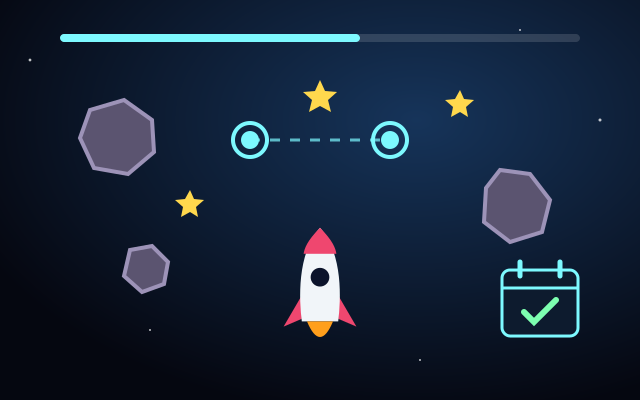
Drag controls let your ship follow your mouse or finger, which feels natural for collection games. In Star Collector, you collect stars and build a combo multiplier by collecting them quickly one after another, while a timer bar shows when the combo will run out. Space mines and comets cross the screen, more over time, and you have three lives.
Collection routes follow a few simple rules:
- Chain nearby stars. Short hops keep the combo alive; long trips let the timer bar run down.
- Sweep, do not zigzag. A curved path through a cluster is faster than darting to whichever star is closest.
- Check crossings. Before committing to a line, look for comets that will cross it. Comets travel across the whole screen, so their paths are worth checking early.
- Keep the action visible. When dragging on a touchscreen, keep your hand as low and out of the way as you can so it does not hide what is ahead; on a keyboard or joystick this is not an issue.
Worked example: flying the Daily Space Challenge
The Daily Space Challenge is the purest test of flight lines on the site. It is a 60-second course generated from the current date (UTC), so everyone gets the same layout on the same day. You fly through gates for a bonus, collect stars and avoid asteroids; each hit costs one of three hull points.
Because the course is fixed for the whole day, you can improve with a simple loop:
- Scout run: fly safely, avoid every asteroid and note roughly where gates and star clusters sit.
- Line run: plan a path that threads the gates in order, taking only the stars that lie on it.
- Refinement runs: add stars that need small detours, one change at a time, and keep what improves your score.
Your best score for today is saved locally, and the Share button uses your device's share feature or copies your result so you can compare with friends. There are no online leaderboards.
Thrust and launch flying
Two of our games go beyond direct steering. In Rocket Landing, you rotate the lander and fire the main engine, and gravity pulls you down constantly, so flying means balancing thrust against a steady downward pull. In Gravity Orbit, you only choose the aim and launch power; after that, planets bend the probe's path, pulling harder when it is closer. These games reward planning more than reflexes. Our rocket arcade games guide covers landing technique in depth.
Arcade flight versus real spaceflight
As a real-world concept, a spacecraft in a vacuum keeps moving at the same speed and direction until a force changes it, because there is no air to slow it down. Turning or stopping takes engine thrust, which uses propellant. Our flying games simplify or leave out this behavior to keep steering readable, and even the thrust-based and gravity-based games use arcade-tuned values. They are games about flying in a space setting, not flight training. For a clearer picture of where the simplifications are, see our space game physics explainer.
Key takeaways
- Identify the movement style first: lane, free, drag, thrust or launch.
- Plan a smooth flight line through the next few seconds instead of reacting to each hazard.
- In collection games like Star Collector, chain nearby targets to keep the combo alive.
- Use the fixed daily layout of the Daily Space Challenge to scout, plan and refine your line.
Explore every title in the Space Flying Games category.