What Are Space Arcade Games?
On this page
A space arcade game is a short, replayable action game set among stars, ships, planets and asteroids, where the goal is to last longer or score higher than your last attempt. This guide explains what the label actually covers, how it differs from space simulations, and which sub-genres you will find in our collection.
The core definition
"Arcade" describes a design style more than a setting. An arcade game is built around a tight loop: you start instantly, play for a few minutes at most, fail, and try again. "Space" is the theme that wraps that loop. Put together, a space arcade game usually has these traits:
- Instant start. No long story, no character creation. You press Start and you are playing within a second.
- Short runs. A typical attempt lasts from thirty seconds to a few minutes.
- Escalating difficulty. The game gets faster, denser or more aggressive the longer you survive, so every run eventually ends.
- A score as the main goal. Progress is measured in points, distance, time or levels reached, and your best result is the thing you chase.
- Simple controls with depth. Often just movement plus one action button, but mastering timing and positioning takes many runs.
- Readable hazards. Threats are clearly drawn and behave consistently, so a loss usually feels like your mistake rather than bad luck.
If a game has most of these traits and takes place in space, it fits the label, whether you are shooting aliens, weaving through meteors or slinging a probe around planets.
Where the genre comes from
Space themes were everywhere in 1970s–80s arcade cabinets. Early vector-graphics asteroid games, classic fixed-screen alien shooters and lander games all used space because it was easy to draw convincingly with limited hardware: a black background, a few bright shapes, and the player's imagination filled in the rest. Those machines were also designed to end sessions fairly quickly, which is where escalating difficulty and the high-score table came from.
Modern browser games keep the same loop but drop the coin slot. Our games run in any up-to-date browser with no download, and instead of a shared cabinet leaderboard they remember your own personal best on your device.
The main sub-genres
"Space arcade" is an umbrella. Most games lean on one core verb, and that verb defines the sub-genre. Here is how our fifteen games map onto the common types:
| Sub-genre | Core verb | Example in our collection |
|---|---|---|
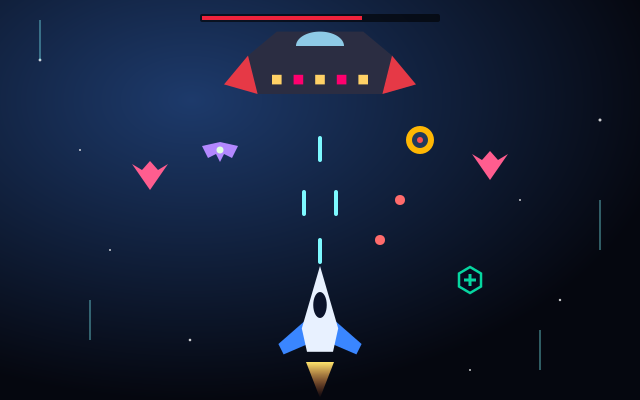
| Shooter | Destroy incoming enemies | Space Shooter, Alien Attack |
| Asteroid / dodger | Avoid falling or drifting rocks | Asteroid Dodge, Meteor Escape |
| Survival | Stay alive as threat levels rise | Space Survival |
| Rocket / lander | Manage thrust and fuel | Rocket Landing, Rocket Rush |
| Planet / orbit | Use or defend planets | Planet Hopper, Galaxy Defender |
| Exploration / collection | Travel, gather and progress | Space Miner, Star Collector |
Many games sit in two or three categories at once. Space Survival, for example, is a survival game first, but it also has asteroids and automatic shooting. You can browse each group from the category pages, such as Space Shooter Games or Space Flying Games.
Arcade games versus space simulations
A space simulation tries to model how real spacecraft behave, often with complex controls and long sessions. A space arcade game borrows the look and a few ideas from real space, then bends them for fun and readability. The difference matters because it sets your expectations.
- In the real world, an object in space keeps moving unless a force acts on it, because there is no air to slow it down. Gravity gets weaker with distance, and orbits are the result of an object falling around a body while moving sideways fast enough to keep missing it.
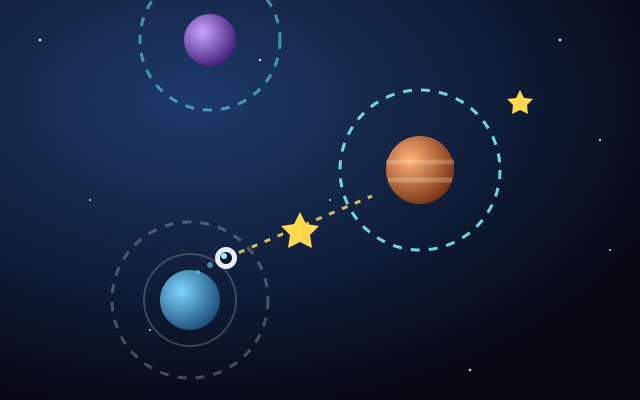
- In our games, those ideas are simplified or left out. In most titles, asteroids simply fall and enemies fly set paths at speeds chosen by the game's difficulty curve. Gravity Orbit does bend your probe's path toward planets, stronger when closer, but with arcade-tuned numbers chosen to make puzzles fair, not to match any real mission.
So enjoy the space setting, but do not treat any arcade game, including ours, as a way to learn real spaceflight or piloting. If you want to see where the games simplify reality, read our explanation of space game physics.
What a typical run looks like
Take Asteroid Dodge as a concrete example of the arcade loop:
- You press Start. Your ship sits near the bottom of the screen and can only move left and right.
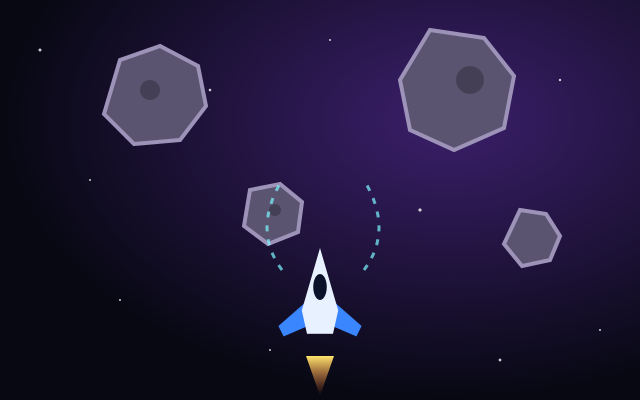
- Rotating asteroids of different sizes fall toward you. At first there are few and they are slow.
- The farther you travel, the faster and denser they get. Passing close to one earns a near-miss bonus, which tempts you to take risks.
- Sometimes a Shield pickup appears; it absorbs one hit.
- One unshielded hit ends the run. Your score is distance plus near-miss bonuses, and if it beats your personal best, the game remembers it.
- You press Play Again, now knowing a little more about how the rocks fall.
Every game in the collection follows a version of this loop, even ones with levels, like Space Miner, where meeting an ore quota moves you on to a harder level.
How browser space arcade games work
Our games are built with standard web technology rather than plug-ins. Graphics are drawn on an HTML canvas, the game updates in sync with your screen using the browser's animation timing, sound effects are generated beeps from the Web Audio API rather than audio files, and keyboard, mouse and touch input come through standard browser events. Your personal best is stored in your own browser's local storage and is never sent to a server, which is why there are no global leaderboards and nothing to sign up for.
Every game also shares the same basic controls outside of gameplay: P pauses, R restarts, a sound toggle mutes the beeps, and on touch devices a control pad appears below the game.
Where to start
If you are new to the genre, pick by difficulty rather than theme:
- Easy: Asteroid Dodge, Cosmic Runner and Star Collector use very few inputs and teach the arcade loop quickly.
- Medium: Space Shooter, Planet Hopper and the Daily Space Challenge add enemies, timing or a fixed course.
- Hard: Rocket Landing, Gravity Orbit, Space Survival and Alien Escape demand precise control or planning under pressure.
Once you have picked a game, our guide on how to play space arcade games walks through your first few sessions, and you can see every title on the all games page.
Key takeaways
- A space arcade game is defined by its loop: instant start, short runs, rising difficulty and a score to beat.
- The genre splits into sub-genres by core verb: shooting, dodging, surviving, piloting rockets, using planets and exploring.
- Arcade games simplify real physics for fun; they are not spaceflight training.
- Our games run in the browser with no accounts and keep your personal best locally.
Sources and further reading
- MDN Web Docs: Canvas API
- MDN Web Docs: Window.localStorage
- MDN Web Docs: Game development
- NASA Space Place (general-audience space science)